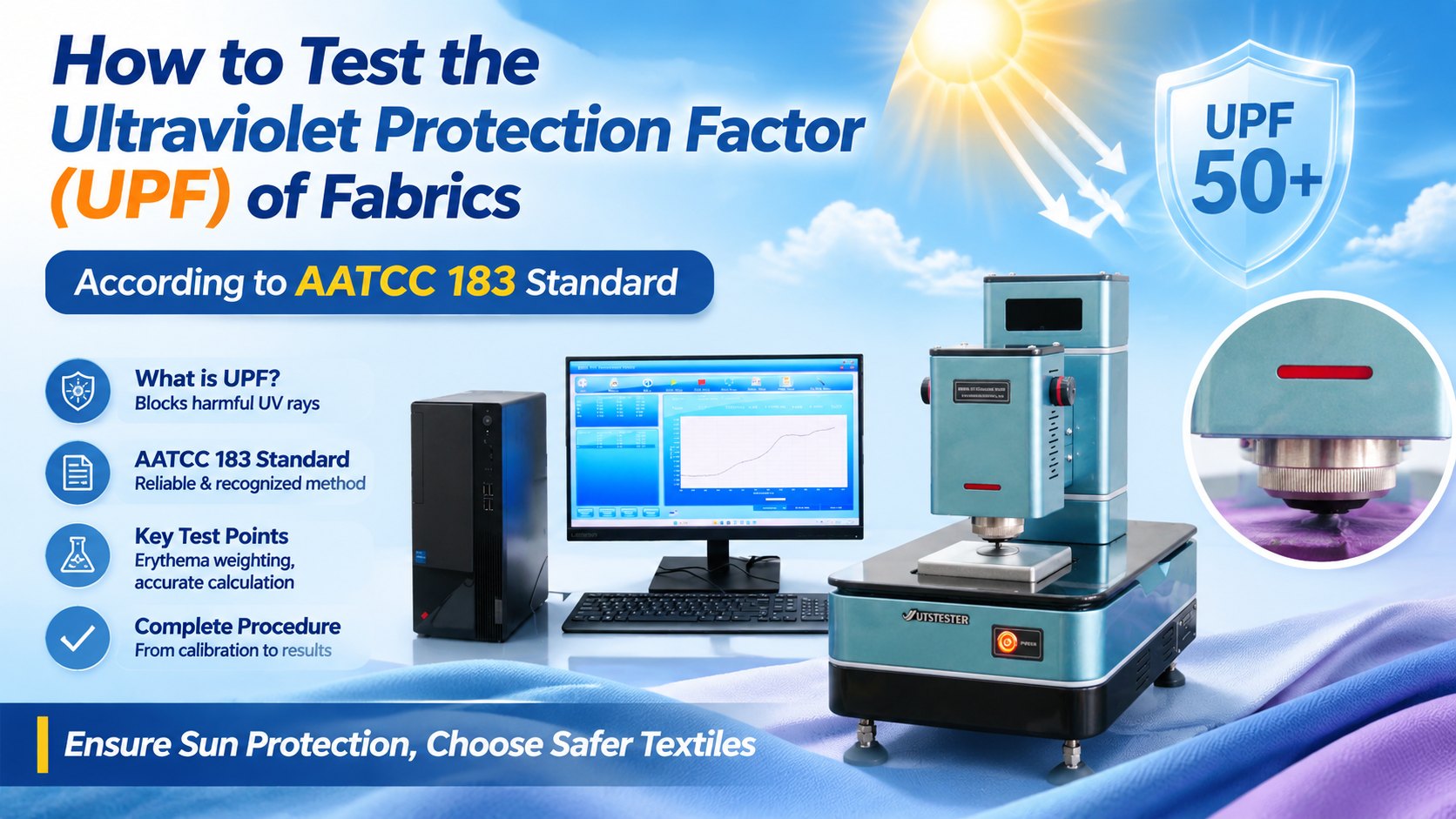
As consumer awareness regarding sun safety and skin health continues to grow, UV-protective textiles have evolved from a niche functional category into an essential, mainstream requirement for apparel, swimwear, outdoor gear, and sun-shading fabrics. AATCC 183 serves as the gold-standard method for testing the UPF of fabrics in the United States.
I. What is UPF, and why is it so important?
UPF (Ultraviolet Protection Factor) is essentially the "SPF" equivalent for textiles; it measures the extent to which a fabric blocks ultraviolet (UV) radiation from reaching the skin's surface.
It can be understood through a simple logic:
- A fabric rated UPF 50 allows only 1/50 (i.e., 2%) of UV radiation to pass through.
- A fabric rated UPF 25 allows only 1/25 (i.e., 4%) of UV radiation to pass through.
A UPF rating is a quantitative value derived from laboratory testing, backed by rigorous standards. Products sold in the U.S. market must be tested according to the AATCC 183 method and must also comply with the labeling specifications set forth in ASTM D6603, as well as the sample pre-treatment requirements outlined in ASTM D6544.
II. What is the AATCC 183 standard?
AATCC TM 183 is an official test method published by the American Association of Textile Chemists and Colorists (AATCC), titled "Transmittance or Blocking of Erythemally Weighted Ultraviolet Radiation through Fabrics." First published in 1998 and subsequently revised several times, the current version is the 2020 edition.
AATCC 183 provides a standardized set of operational procedures for using specialized equipment to direct UV radiation at a fabric, measuring the amount that penetrates, and ultimately calculating an official UPF value. Key Information About the Standard:
- Covers the entire ultraviolet (UV) spectrum from 280 nm to 400 nm (including both UVA and UVB).
- Supports testing in both dry and wet conditions (particularly important for swimwear and sportswear intended for use during activities involving perspiration).
- Provides three core results: UPF value, UVA transmittance, and UVB transmittance.
- Serves as the mandatory testing basis for assigning a UPF rating to products under the ASTM D6603 labeling specification.
III. Core Principles
1. What is "erythema weighting," and why not simply measure the total amount of UV radiation?
Different wavelengths of UV radiation have varying capacities to cause sunburn (erythema/reddening of the skin). UVB (280–315 nm) is far more effective at inducing sunburn and redness than UVA (315–400 nm). Therefore, rather than treating all UV wavelengths equally, the test applies a weighting curve that corresponds to how human skin actually reacts to different wavelengths.
2. The Basic UPF Calculation Formula
In essence, UPF is a ratio:
UPF = UV energy detected without the fabric present ÷ UV energy detected with the fabric present
When no fabric is present, all UV radiation reaches the detector, serving as the baseline value. When the fabric is introduced, only a portion of the UV radiation can pass through. Dividing the baseline value by the amount that penetrates yields the protection factor.
For example:
- Baseline value (no fabric): 100 units of erythema-weighted UV radiation
- With fabric: 2 units of UV radiation penetrate
- UPF = 100 ÷ 2 = 50
In actual testing, this calculation is performed for every individual wavelength within the 280–400 nm range, which are then aggregated to produce a final, comprehensive UPF value. IV. Complete Procedure for AATCC 183 UPF Testing
Step 1: Instrument Setup and Calibration
UPF testing requires a UV spectrophotometer or spectroradiometer equipped with an integrating sphere. This is not a standard color-measurement instrument; it must be capable of covering the entire ultraviolet spectrum, down to 280 nm.
Before testing any samples, the instrument must undergo three types of calibration:
1. Wavelength Accuracy Calibration: Verify wavelength precision using a mercury lamp or a holmium oxide filter.
2. Transmittance Calibration: Calibrate for 100% transmittance with an empty sample port (using air as a reference), and verify 0% transmittance using an opaque block.
3. Linearity Verification: Confirm the accuracy of readings across the full intensity range using neutral-density filters.
Step 2: Sample Preparation
Cut the fabric to a size that fits the instrument’s sample port. The standard requires that the test sample be representative of the fabric’s typical construction.
- Patterned/Multicolored Fabrics: You must test the area with the highest UV transmittance (i.e., the point with the weakest protection) rather than the area with the best performance. This ensures that the UPF rating indicated on the product label is conservative and reliable.
- Wet-State Testing: For wet-state testing, samples must be saturated with distilled water to a specified moisture content. This is mandatory for swimwear and sportswear, as the UPF of most fabrics decreases significantly when wet.
If the test results are intended for product labeling, the samples must also undergo pre-treatment—such as laundering, light exposure, or stretching—in accordance with the ASTM D6544 standard to simulate the condition of the product after actual use.
Step 3: Three-Angle Measurement Protocol
Textiles are not uniform materials; the orientation of the yarns can influence test results. AATCC 183 requires three measurements to be taken at each test location:
1. A measurement in the original orientation (0°).
2. A second measurement after rotating the sample by 45°.
3. A third measurement after an additional 45° rotation (a total of 90°).
The average of these three results is calculated to mitigate the influence of yarn orientation and prevent a single "optimal" angle from artificially inflating the final value.
Step 4: Calculating UPF, UVA Blocking, and UVB Blocking
The instrument’s software collects spectral transmittance data across the entire UV range. By applying the erythemal action spectrum and solar spectral irradiance weightings, it automatically calculates:
- Overall UPF value: A single protection factor rating.
- Average UVA transmittance: The proportion of UVA radiation that passes through the fabric.
- Average UVB transmittance: The proportion of UVB radiation that passes through the fabric.
- UV blocking percentage: A metric commonly used for marketing and consumer information.
Step 5: Determining the Final UPF Rating
When determining a rating for product labeling (in accordance with ASTM D6603), the final value is more conservative than the raw test average: the labeled value is rounded down to the nearest standard rating tier. If both the original (as-received) and pre-conditioned samples are tested, the label must reflect the lower of the two results.
This is why common labels read "UPF 30+" or "UPF 50+" rather than precise decimal figures—the "+" indicates that the actual test result meets or exceeds that specific tier, inherently providing a built-in safety margin.
Title (H1): How to Test Fabric UPF (AATCC 183): Step-by-Step Lab Guide
Meta description: How to test fabric UPF to AATCC 183: sample conditioning, dry vs wet measurement, the UPF formula, UVA/UVB blocking, and choosing a UPF tester.
Email: hello@utstesters.com
Direct: + 86 152 6060 5085
Tel: +86-596-7686689
Web: www.utstesters.com


 +86 152 6060 5085

 English
 русский
 español
 português
 العربية
 Polski




 hello@utstesters.com
 hello@utstesters.com
 +86 152 6060 5085
 +8615260605085
