A Universal Strength Tester is a long-term lab capability, not a one-time equipment buy. Choose poorly and the costs compound: a load capacity that mismatches your specimens, grips that let samples slip and distort elongation readings, or software that cannot produce audit-ready reports. Grip problems hide easily, because a slipping specimen and a genuinely weak material both return a low result.
Before you request quotes, define your test types and materials, then weigh load capacity, speed, grips, software, safety, compliance, frame type, and cost. A Single Column Tensile Testing Machine suits light loads and tight bench space; a Computerized Universal Tensile Tester adds method control and reporting depth. UTS International supports specification guidance and application fit.
Key Takeaways
-
Define your test types and materials first. This step guides every other choice.
-
Size load capacity with 20–30% headroom above your highest expected force. This protects against stronger batches.
-
Choose grips and software that match your standards. They ensure accurate and repeatable results.
-
Check safety features and compliance. They keep operators safe and reports audit-ready.
-
Compare total cost over five years, not just the frame price. Include grips, software, calibration, and spare parts.
What a Universal Strength Tester Does
Core Capabilities and Test Types
Confirm the instrument category before you compare models. A compression testing machine (CTM) applies compressive force only, often through platens, and suits dedicated work such as concrete, bricks, and packaging. A universal testing machine (UTM) supports multiple loading modes through interchangeable grips and fixtures.
|
Aspect
|
CTM
|
UTM
|
|
Primary loading
|
Compression only
|
Tension, compression, flexure, shear
|
|
Typical industries
|
Construction, packaging
|
Metals, plastics, rubber, composites
|
|
Flexibility
|
Focused on compression
|
Broad, fixture-dependent
|
The same logic separates a tensile tester from a UTM. A tensile tester is built mainly for uniaxial pull tests, while a UTM covers tension, compression, bending, shear, and peel with the right accessories.
Terminology varies between manufacturers, so confirm a machine's actual capabilities rather than relying on its name.
A capable Universal Strength Tester should handle tensile, compression, flex, peel, puncture, friction, and shear testing when configured correctly. Ease of use matters just as much. Simple specimen installation and straightforward method configuration decide how quickly your team moves between test types.
Where It Fits in a Lab Workflow
A UTM serves as a shared platform for empirical data verification, failure analysis, and routine quality checks. One machine covers several test types, so you avoid buying a separate instrument for every method. An Electronic Universal Tensile Strength Tester with an intuitive software interface reduces manual intervention and improves repeatability across operators.
Plan the surrounding workflow as carefully as the machine itself. Allow footprint plus operator clearance, keep specimen preparation space nearby, and mark a safety zone. Network integration and CSV or Excel export help multi-user labs move results into statistical analysis without rekeying data.
Match the Tester to Your Tests
Materials and Load Capacity
Start with the maximum force your specimens will generate, then add headroom. A 20% margin above the highest expected force protects you against stronger-than-expected batches. Consider a 16 mm bar with a nominal cross-sectional area of 201.1 mm². At a design ultimate tensile strength of 650 MPa, the highest expected force reaches 130.7 kN. Applying the 20% margin gives roughly 157 kN, so a machine rated near that figure fits the job. The 30% end of the range gives extra room for method variation.
Match that figure to your material class:
|
Load Capacity
|
Typical Applications
|
|
1–5 kN
|
Films, textiles, small flexible materials
|
|
5–50 kN
|
Plastics, rubber, adhesives, general composites
|
|
50–300 kN
|
Metals, high-strength composites, structural materials
|
|
300 kN+
|
Heavy industrial and structural testing
|
Aim for a typical ultimate tensile strength test to fall within 10%–90% of machine capacity. An 8 kN failure load suits a 10 kN or 20 kN configuration far better than a 1000 kN system. Undersizing pushes you outside the measurement range and shortens equipment life. Oversizing dulls sensitivity at low forces and raises cost without benefit. Confirm specimen thickness, shape, and form before sizing, because geometry decides which grips work and what force range is realistic. Distinguish frame capacity from load-cell capacity, and check accuracy class alongside resolution. For strict standards, look for force accuracy of ±1% or better; premium systems such as Instron's 2580 Series reach ±0.5% of reading.
Speed, Grips, and Fixtures
Standards dictate sample size, test speed, and fixture type, so configure each method in software before you commit. Set the test speed, enter specimen dimensions, and define end-of-test criteria such as break detection. A Computerized Universal Tensile Tester stores these parameters as reusable methods, which keeps results consistent across operators.
Grips decide whether those methods hold up. Mechanical vise grips suit sheet plastics, fine metals, paper, and textiles. Wedge-action grips handle rigid plastics, metals, and composites. Drum or eccentric roller grips hold high-elongation rubber and polymers. Peel fixtures serve labels, tapes, and adhesives, while compression platens cover springs, cans, bottles, and foam. Standards-specific tooling matters too: ISO 527-1 hydraulic wedge grips for plastics, ISO 178 three-point flexure, and ASTM D5379 Iosipescu shear fixtures each match a named method. Easy fixture replacement lets one Universal Strength Tester switch between standards without downtime.
Software, Safety, and Compliance
Data Analysis and Reporting
Software turns raw force and displacement data into decisions. Modern Universal Strength Tester software delivers real-time analytics, so your team can act on quality signals during a test run rather than after it. Tightening regulatory standards now push vendors toward enhanced traceability, including user tracking, audit trails, and improved security. These functions keep material test data detailed, replicable, and verifiable against safety and documentation requirements.
Evaluate the core outputs your reports must capture:
-
Ultimate Tensile Strength (UTS)
-
Yield Strength
-
Stress vs. Strain Curve
-
Proof Load
-
Time to Failure
A Computerized Universal Tensile Tester should record each metric reliably and export it without rekeying. Accurate, repeatable results define audit-ready reporting, so confirm the software's calculation methods before purchase.
ASTM/ISO Compliance and Safety
Standards decide sample preparation, test speed, and reporting format. ASTM is a US-based standard accepted globally for detailed, material-specific procedures; ISO is an international standard widely adopted in Europe and Asia. For metal tensile testing, ASTM E8 relies on stress-rate or crosshead control, while ISO 6892-1 aims to minimize measurement variation across different machines. Load cell accuracy matters for compliance with ASTM E4.
|
Material
|
ASTM
|
ISO
|
|
Metals (tension)
|
E8/E8M
|
6892-1
|
|
Rigid plastics
|
D638
|
527-1 & 527-2
|
|
Elastomers
|
D412
|
37
|
|
Composites (tension)
|
D3039
|
14125
|
An Electronic Universal Tensile Strength Tester with guarded moving parts, limit switches, and an emergency stop protects operators during high-force tests. A Single Column Tensile Testing Machine fits light-load methods within a compact safety envelope.
Selecting a Universal Strength Tester: Frame and Cost
Single-Column, Dual-Column, and Floor-Standing
Frame configuration follows force and specimen size. Single-column testers use a cantilever design for low-force work under 5 kN, and advanced models reach up to 10 kN. They sit on a standard lab bench with no dedicated foundation. A Single Column Tensile Testing Machine suits films, textiles, and small flexible parts, but you should not use it for large rigid specimens.
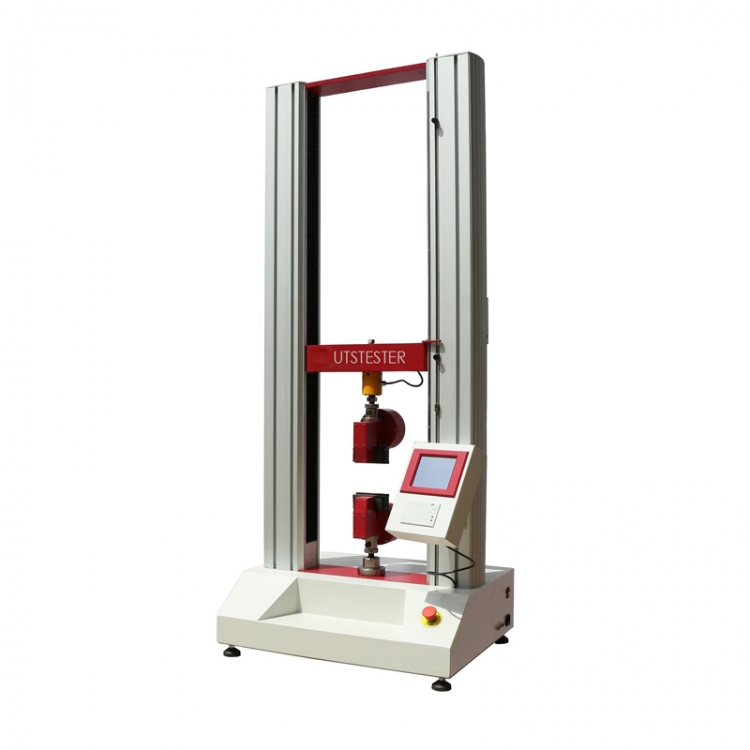
Dual-column testers use a closed-loop H-frame that handles high-force loads up to 3,000 kN without bending. They start at 10 kN and come as tabletop or floor-standing units. Floor-standing versions carry greater size and weight, so they may need a flat, reinforced ground installation.
|
Model
|
Type
|
Test space width
|
Crosshead travel
|
Weight
|
|
MBIOI-10-M2
|
Single column
|
150 mm
|
890 mm
|
105 kg
|
|
MBIOII-50-M2
|
Dual column
|
425 mm
|
1,300 mm
|
190 kg
|
|
MBIOII-200-M2
|
Dual column
|
605 mm
|
1,500 mm
|
760 kg
|
Check horizontal clearance and vertical travel against your largest fixture, not just your average specimen. A wide peel fixture or a deep flexure rig can exceed a narrow column gap.
Work through this checklist before you request quotes:
-
Confirm force capacity and stroke match your specimen types.
-
Select a servo-driven system if high precision is required.
-
Verify supported test modes and fixture customization availability.
-
Check measurement accuracy class and load-cell service cycles.
-
Choose ball-screw transmission for high-repeatability work.
-
Evaluate software functionality, report export, and standards compliance.
-
Confirm emergency-stop, overload protection, and travel limits.
Budgeting for Versatility and Upgradability
Price the whole system, not the frame alone. Your quotation scope should cover frame, load cells, grips, extensometers, software licenses, and installation. An extensometer is often the second-largest purchase after the frame, and most ASTM and ISO tensile standards require one. Software and test methods are separate budget items, priced per standard with reporting and data export.
Plan the timeline and support costs too. Standard delivery often runs 4–12 weeks depending on configuration. On-site commissioning and operator training typically take 1–3 days. Budget for annual calibration, a spare parts strategy for jaws, belts, sensors, and cables, and a service response window you can live with.
Future-proof your investment: select equipment that can grow with your testing needs.
Upgradability changes the math. Confirm the upgrade path for new fixtures, chamber interfaces, and software modules before you sign. A shared testing platform across sites also reduces retraining and improves comparability. Accessory and service expenses over 3–5 years can materially change the apparent value of the original quote, so compare total ownership rather than sticker price. Every configuration above has a fit; the right Universal Strength Tester is the one whose frame, accessories, and support match your methods today and your growth tomorrow.
Define your test types and materials first. Size load capacity next, keeping 20–30% headroom above your highest expected force. Then select speed, grips, software, and safety features. An Electronic Universal Tensile Strength Tester that meets ISO 7500-1 calibration and ASTM E4 force verification clears your compliance filter.
Apply total cost of ownership as the final filter. Price grips, fixtures, software, calibration, and spare parts across five years, not the frame alone. A Computerized Universal Tensile Tester with a documented upgrade path protects that investment.
Before you request quotes, confirm four things:
-
Your full material range and force limits.
-
A clause-by-clause standards mapping from each supplier.
-
A live demo with your own sample.
-
Training and installation inside the contract.
A Single Column Tensile Testing Machine suits light loads; confirm fit with UTS International before you commit.
FAQ
How much load capacity headroom should you plan for?
Add 20–30% above your highest expected force. A batch that runs stronger than your design value will otherwise push the machine past its range. Check that a typical ultimate tensile strength test lands between 10% and 90% of capacity, and confirm the figure with a Computerized Universal Tensile Tester demo using your own samples.
Can one machine really cover tensile, compression, peel, and shear work?
Yes, when you configure it correctly. A universal platform switches between these modes through interchangeable grips and fixtures, so one frame serves several methods. Confirm fixture availability for each standard you run before you buy, and ask for a clause-by-clause standards mapping from every supplier.
When should you choose a single-column frame instead of a dual-column model?
Pick a single-column frame for low-force work under 5 kN, where bench space is tight and specimens stay small. A Single Column Tensile Testing Machine handles films, textiles, and small flexible parts well. Move to a dual-column or floor-standing unit once force, specimen size, or fixture width exceeds that envelope.
What software features make reports audit-ready?
Look for user tracking, audit trails, and secure data handling alongside the core outputs: ultimate tensile strength, yield strength, the stress-strain curve, proof load, and time to failure. An Electronic Universal Tensile Strength Tester should export these metrics directly to CSV or Excel, so your team avoids rekeying results.
How long does delivery and commissioning take?
Standard delivery often runs 4–12 weeks, depending on configuration. On-site commissioning and operator training typically take 1–3 days. Build annual calibration and a spare parts plan for jaws, belts, sensors, and cables into your budget, and confirm a service response window you can accept.


 +86 152 6060 5085

 English
 русский
 español
 português
 العربية
 Polski




 hello@utstesters.com
 hello@utstesters.com
 +86 152 6060 5085
 +8615260605085
