A respirabilidade impacta diretamente o conforto do usuário, principalmente em roupas esportivas e equipamentos para atividades ao ar livre. Tecidos respiráveis absorvem o suor com eficácia, mantendo a pele seca para aumentar o conforto e o desempenho atlético. No design de vestuário esportivo, a respirabilidade é um fator crucial — os designers devem garantir que os materiais selecionados proporcionem fluxo de ar adequado durante atividades intensas.
I. Definition of Breathability
Breathability refers to the ability of gases to pass through polymers, including films, coatings, and fabrics. “Vapor permeability” specifically denotes the capacity of water vapor to traverse fabrics, also termed “moisture permeability” within the industry. Ensuring comfort requires meeting both air permeability and vapor permeability requirements.
Fabric breathability measures the ability of air to pass through the material. It is tested by creating a pressure differential across the fabric. Specifically, it is the pressure differential across the fabric. It represents the volume of air flowing through a unit area of the fabric per unit time. The common unit is mm/s. Air requires a pressure differential to flow. The fabric must maintain this pressure differential to generate airflow.
II. Testing Principle
When a pressure differential exists across the fabric, air flows through it. Flow rate is the volume of air passing through a unit area of the fabric per unit time. The common unit is mm/s. Because a pressure differential is essential for airflow.
Only a pressure differential enables air movement. Therefore, the fabric on both sides must maintain a certain pressure differential to allow air passage. Breathability impacts fabric comfort. It affects the fabric's thermal insulation and warmth retention. Fabric breathability is crucial for the body. It transfers heat, moisture, and gases like carbon dioxide to the outside.
III. Why Sportswear Requires Breathability
During exercise, the human metabolic rate increases dramatically, generating significant heat and sweat. Data indicates that during high-intensity exercise, the human body can sweat 0.5-2 liters per hour. At this point, the core mission of athletic apparel is to rapidly dissipate heat and expel sweat, maintaining the balance of the “microclimate” between the skin and the garment—the temperature, humidity, and airflow velocity of this microclimate directly determine wearing comfort.
Well-ventilated athletic apparel creates efficient airflow channels, allowing cool external air to enter while expelling warm internal air for effective heat exchange. Simultaneously, moisture-wicking properties rapidly transport sweat from the skin's surface to the outer fabric layer for evaporation, preventing the sticky discomfort caused by sweat buildup. Conversely, poorly breathable garments act like an “airtight barrier,” trapping heat and sweat between skin and fabric. This raises perceived body temperature by 2-3°C, causing intense discomfort and increasing the risk of skin friction injuries.
Breathability testing scientifically quantifies a fabric's air transmission capacity, ensuring clothing maintains its “thermoregulatory” function across varying exercise intensities.
IV. Performance Impact of Apparel Breathability
For professional athletes or enthusiasts pursuing athletic efficiency, breathability not only affects comfort but directly impacts performance. Sports medicine research indicates that insufficient breathability in clothing causes sustained increases in core body temperature, leading to accelerated heart rate and heightened physical exertion. This can reduce exercise endurance by over 18%.
Different athletic scenarios demand varying levels of breathability, and breathability testing enables companies to achieve “precise matching.” For instance: - Polyester fabrics commonly used in running apparel must ensure an air permeability rate ≥120mm/s to manage sustained heat generation; Nylon fabrics for mountaineering apparel must prioritize moisture evaporation rates ≥550g/m²/h to meet sweat management demands in variable outdoor conditions; while elastic garments like yoga wear require testing for breathability changes ≤10% after 20% stretch to ensure stable ventilation during movement.
Additionally, breathability and fabric dynamic adaptability must be validated through testing. Body movements and fabric stretching during exercise alter pore structures. Dynamic breathability testing simulates real-world motion to ensure garments maintain consistent breathability under conditions like stretching and friction, preventing performance degradation due to breathability failure during activity.
V. Apparel
Fabric Breathability Testing Instruments
The precision of breathability testing directly relies on specialized testing instruments. High-quality
textile testing equipment
can simulate various environmental conditions (temperature, humidity, pressure differential) to accurately measure multiple indicators such as air permeability, moisture resistance, and thermal resistance, providing enterprises with comprehensive and reliable performance data.
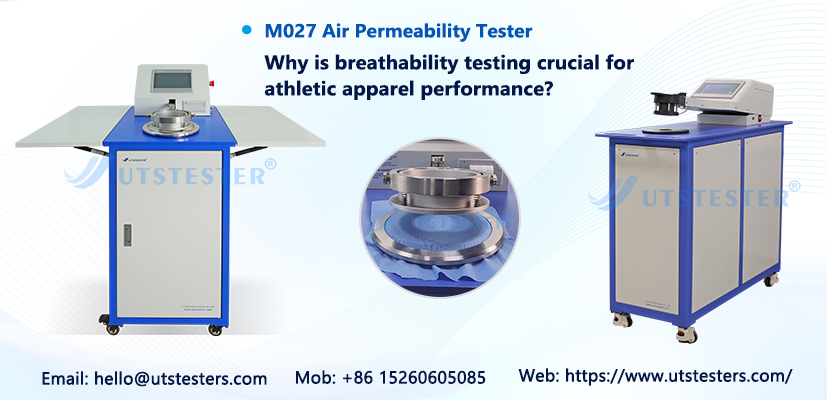
Digital breathability testers deliver reliable results quickly. They are suitable for breathability testing of various textiles. This includes technical textiles, nonwovens, and other breathable products. It complies with standards such as GB/T5453, GB/T13764, ISO9237, ISO7231, ISO5636, ASTM D737, DIN 53887, JIS L1096, BS5636, and others.
Air flows vertically through the fabric. This creates a pressure difference between the front and back surfaces of the fabric. We measure the airflow rate through the fabric at a set pressure differential. This yields the air permeability value.
Conclusion: Prioritizing Air Permeability Testing to Create Truly “High-Performance Sportswear”
From wear comfort to athletic performance, from health safety to market competitiveness, air permeability is an indispensable core performance characteristic of sportswear. Air permeability testing serves as the “critical link” in ensuring this performance. It not only provides enterprises with precise performance data to support R&D upgrades and quality control but also enables consumers to purchase functional sportswear that genuinely meets their needs.
As a dedicated player in the textile testing instrument field, we remain committed to delivering breathability testing solutions compliant with international and domestic standards. This empowers enterprises to accurately control product breathability performance and enhance their core competitiveness.
Email:
hello@utstesters.com
Direct: + 86 152 6060 5085
Tel: +86-596-7686689
Web:
www.utstesters.com


 +86 152 6060 5085
 English
 русский
 español
 português
 العربية
 Polski



 hello@utstesters.com
 hello@utstesters.com
 +86 152 6060 5085
 +8615260605085