Em grandes projetos, como obras de conservação de água, rodovias, ferrovias e proteção ambiental, os geotêxteis atuam como “guardiões invisíveis”. Suas funções principais — separação, filtração, reforço e drenagem — determinam diretamente a estabilidade estrutural do solo e a segurança da obra a longo prazo. Seja para o controle de infiltração em barragens, reforço de leitos rodoviários, proteção de taludes ou drenagem subterrânea, o desempenho dos geotêxteis é crucial. Testes precisos e abrangentes são o processo fundamental para garantir seu desempenho ideal e mitigar os riscos do projeto.
I. Funções dos geotêxteis
Os geotêxteis são materiais geossintéticos permeáveis fabricados a partir de fibras sintéticas por meio de processos como agulhamento ou tecelagem. Eles são classificados em geotêxteis tecidos, não tecidos e compósitos, com suas funções atendendo diretamente às principais necessidades da engenharia:
1. Filtração e contrafiltração
A filtração é uma das principais funções dos geotêxteis. Quando a água permeia camadas de solo de granulometria fina para camadas de granulometria grossa, os geotêxteis atuam como "filtros inteligentes", permitindo a passagem da água enquanto retêm firmemente as partículas finas do solo. Isso previne riscos induzidos pela erosão do solo, como erosão interna e fluxo de solo. A função de filtração reversa impede a perda de material de enchimento em estruturas de drenagem durante o fluxo reverso da água, mantendo a integridade do solo circundante. Essa capacidade é particularmente crítica em drenos cegos de plástico e sistemas de drenagem de barragens. Um desempenho de filtração inadequado não apenas entope os canais de drenagem, mas também perturba a estrutura do solo, causando, em última instância, recalque e colapso do projeto.
2. Reforço e Separação
Em leitos de estradas, taludes e projetos similares, os geotêxteis aumentam a resistência à tração e à deformação do solo por meio do reforço, dispersando tensões concentradas para evitar rupturas do solo sob forças externas. Simultaneamente, sua função de separação promove a segregação de materiais de construção com diferentes propriedades físicas (granulometria, densidade, consistência), impedindo a mistura do solo com agregados, concreto, etc. Isso mantém a integridade estrutural e a capacidade de carga dos materiais, estabelecendo as bases para a estabilidade do projeto. Além disso, os geotêxteis oferecem funções auxiliares como proteção, drenagem e resistência à perfuração, formando um sistema abrangente de proteção em engenharia.
II. Principais itens de teste
O desempenho dos geotêxteis deve ser validado por meio de testes multidimensionais que abrangem quatro categorias principais: propriedades físicas, propriedades mecânicas, propriedades hidráulicas e durabilidade. Cada teste corresponde diretamente à capacidade do material de garantir a estabilidade do solo e a eficiência de filtração.
1. Teste de propriedades físicas
As propriedades físicas constituem a base da funcionalidade dos geotêxteis. Os principais testes incluem:
1.1 Gramatura: Determinada por pesagem (conforme a norma GB/T 13762), esta métrica está diretamente relacionada à espessura, resistência e controle de custos do geotêxtil. Os desvios devem estar dentro de ±8% (pequenas variações podem ocorrer para diferentes especificações). Gramatura insuficiente compromete a resistência, enquanto gramatura excessiva pode prejudicar a permeabilidade.
1.2 Medição da Espessura: Medida utilizando um medidor de espessura de geotêxtil sob pressão especificada (norma GB/T 13761). A espessura impacta diretamente a porosidade e a capacidade de drenagem. Por exemplo, um geotêxtil de fibra curta de 100 g/m² deve ter uma espessura mínima de 0,9 mm, enquanto as especificações de 600 g/m² exigem uma espessura mínima de 4,1 mm.
1.3 Qualidade Visual: Inspecione visualmente a superfície para verificar a uniformidade, vincos, rasgos, impurezas ou outros defeitos. Qualquer imperfeição estética pode se tornar um ponto de concentração de tensão, comprometendo a resistência a rasgos e perfurações durante o uso.
2. Testes de propriedades mecânicas
As propriedades mecânicas determinam a eficácia do reforço e da proteção dos geotêxteis, servindo como a principal defesa contra danos externos. Os principais itens de teste incluem:
2.1 Resistência à Tração e Alongamento na Ruptura: Realizados por meio de ensaio de tração em faixa larga (GB/T 15788) utilizando uma máquina de ensaio universal para determinar a tensão máxima de tração longitudinal/transversal e as taxas de deformação. Isso garante resistência e alongamento suficientes tanto em condições secas quanto úmidas. Por exemplo, um geotêxtil de fibra curta de 200 g/m² deve apresentar uma resistência à ruptura longitudinal de no mínimo 6,5 kN/m.
2.2 Resistência ao Rasgo e à Perfuração: A resistência ao rasgo é testada pelo método trapezoidal de acordo com a norma GB/T 13763, enquanto a resistência à perfuração é avaliada pelo ensaio de perfuração CBR (GB/T 14800). Esses ensaios avaliam a capacidade do geotêxtil de suportar perfurações e rasgos durante a construção e o uso, prevenindo falhas catastróficas decorrentes de danos localizados.
2.3 Resistência à Abrasão: Testado utilizando o método de lixa/deslizador (GB/T 17636) para simular o atrito com solo e cascalho em aplicações de engenharia. Isso garante durabilidade a longo prazo contra desgaste abrasivo, sendo particularmente adequado para ambientes de alto atrito, como leitos de estradas e taludes.
3. Testes de desempenho hidráulico
As propriedades hidráulicas determinam diretamente a eficiência da filtração e a eficácia da drenagem, constituindo a principal verificação da funcionalidade dos geotêxteis:
3.1 Coeficiente de Permeabilidade Vertical: Medido usando um
testador de permeabilidade vertical de geossintéticos
(conforme a norma GB/T 17633) para avaliar a penetração do fluxo de água através do tecido. Os valores devem ser controlados entre 1,0×10⁻¹⁰ e 9,9×10⁻¹⁰ cm/s para garantir a passagem suave da água. 3.2 Tamanho Efetivo dos Poros: Determinado por meio de métodos de peneiramento a seco ou úmido (GB/T 14799), sendo a métrica principal O₉₅ (95% dos poros menores que esse valor). Normalmente controlado entre 0,07 e 0,2 mm, esse tamanho retém partículas finas de solo sem causar bloqueio devido ao tamanho excessivamente pequeno, alcançando um equilíbrio entre “retenção e drenagem do solo”.
4. Testes de durabilidade
As aplicações de engenharia frequentemente se estendem por décadas, exigindo que os geotêxteis resistam à erosão ambiental complexa. Os testes principais incluem:
4.1 Resistência ao envelhecimento e à corrosão: Simulação da exposição aos raios UV e flutuações de temperatura por meio de câmaras de envelhecimento em alta temperatura (GB/T 17631) e verificação da estabilidade em solos e corpos d'água ácidos/alcalinos utilizando
testadores de resistência a ácidos e álcalis
(GB/T 17632). Isso garante que a retenção da resistência à tração atenda aos requisitos do projeto — por exemplo, mantendo a retenção da resistência longitudinal e transversal especificada após 3 dias de imersão em ácido sulfúrico 0,025 mol/L ou solução saturada de hidróxido de cálcio.
4.2 Resistência Microbiana: Testa a resistência a microrganismos e danos causados por insetos para prevenir a degradação em ambientes de solo úmido e manter a estabilidade do desempenho.
III. Padrões e instrumentos de teste
Testes precisos dependem de um sistema padrão abrangente e de instrumentos profissionais, que, em conjunto, garantem a autoridade, a exatidão e a comparabilidade dos resultados dos testes.
1. Padrões Essenciais de Teste
A China estabeleceu um sistema abrangente de normas de teste para geotêxteis, que abrange tanto normas de produto quanto normas de método. As normas principais incluem:
1.1 Normas de Produto: “Geotêxtil não tecido agulhado de fibra curta” (GB/T 17638-2017), “Geotêxtil não tecido agulhado spunbonded de filamento” (GB/T 17639-2008), “Geomembrana composta” (GB/T 17642-2018), etc., que especificam os requisitos de desempenho para diferentes tipos de geotêxteis.
1.2 Normas de método: Ensaio de tração (GB/T 15788), Ensaio de rasgo (GB/T 13763), Determinação do coeficiente de permeabilidade (GB/T 17633), etc., padronizando os procedimentos de ensaio e os detalhes operacionais.
1.3 Especificações da Indústria: Especificações especializadas para setores como engenharia rodoviária (JT/T 520-2017) e engenharia de construção, definindo regras de amostragem e requisitos específicos do projeto.
2. O Papel Crítico dos Instrumentos de Teste Profissionais
Os instrumentos de teste têxtil são ferramentas essenciais para a obtenção de medições precisas. Adaptados às características dos geotêxteis, requerem uma série de equipamentos especializados:
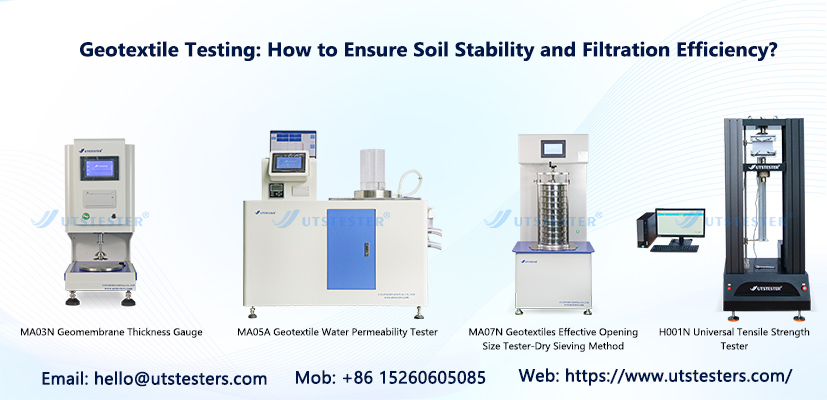
2.1 Instrumentos para Testes de Desempenho Mecânico: Máquinas de ensaio universais e máquinas de ensaio universais eletrônicas controladas por computador para testes de resistência à tração, ao rasgo e à perfuração, garantindo dados precisos e rastreáveis.
2.2 Instrumentos para teste de desempenho hidráulico: Permeâmetros verticais e analisadores de tamanho de poro efetivo para controle preciso dos parâmetros de fluxo, determinação dos coeficientes de permeabilidade e distribuição do tamanho dos poros.
2.3 Instrumentos para testes físicos e de durabilidade: Sistemas automáticos de detecção de massa por unidade de área/espessura de geotêxteis, câmaras de envelhecimento em altas temperaturas e testadores de resistência a ácidos e álcalis permitem testes em lote eficientes e simulação ambiental.
Os instrumentos de teste profissionais não apenas atendem aos requisitos padrão, mas também fornecem análises de dados inteligentes. Isso oferece orientação precisa para a seleção de projetos e o controle de qualidade, mitigando os riscos de engenharia causados por desvios nos testes.
IV. Conclusão
Como o “guardião invisível” da construção civil, os geotêxteis dependem de testes e inspeções abrangentes e de alto padrão para garantir a estabilidade do solo e a eficiência de filtração. Do controle fundamental das propriedades físicas à verificação precisa do desempenho mecânico e hidráulico, e à avaliação da durabilidade a longo prazo, cada teste carrega a responsabilidade crítica pela segurança da obra. Olhando para o futuro, à medida que as demandas por desempenho dos geotêxteis continuam a aumentar, as tecnologias e os instrumentos de teste passarão por constantes iterações e avanços. Somente aderindo aos princípios fundamentais dos testes científicos é que os geotêxteis poderão atingir seu pleno potencial, salvaguardando a estabilidade e a operação a longo prazo de grandes projetos de engenharia.
E-mail:
hello@utstesters.com
Telefone direto: +86 152 6060 5085
Telefone: +86-596-7686689
Web:
www.uttesters.com


 +86 152 6060 5085
 English
 русский
 español
 português
 العربية
 Polski



 hello@utstesters.com
 hello@utstesters.com
 +86 152 6060 5085
 +8615260605085