Nos últimos anos, com a melhoria dos padrões de vida, o interesse das pessoas por roupas com tecnologia de absorção de umidade e secagem rápida tem crescido constantemente. Os consumidores agora reconhecem a capacidade dessas peças de absorver a umidade, proporcionar respirabilidade e eliminar o suor. Isso é particularmente comum em atividades esportivas. Muitas marcas globais incorporam tecidos com essa tecnologia em suas linhas de roupas. Devido ao crescimento social e econômico, a demanda por tecidos funcionais continua a aumentar. A pesquisa sobre tecidos com essa tecnologia é contínua e avalia o desempenho do tecido na transferência de calor e umidade quando o corpo humano transpira. Isso auxilia na avaliação da funcionalidade do tecido.teste de taxa de secagem de tecidoMede a rapidez com que a umidade evapora de um tecido sob condições específicas. Seu princípio fundamental envolve o cálculo da perda de umidade por unidade de tempo, monitorando as mudanças na massa ou no teor de umidade do tecido durante o processo de secagem.
1. O que é um tecido de alta taxa de secagem?
Tecidos com secagem rápida absorvem e eliminam o suor com rapidez. Esses materiais são geralmente altamente respiráveis e absorvem a umidade, permitindo que a transpiração evapore rapidamente, mantendo o corpo seco e confortável. Abaixo, um resumo dos tecidos de secagem rápida mais comuns.
Poliéster: Absorve rapidamente o suor da pele e depois evapora.
Nylon: Excelente respirabilidade e absorção de umidade, adequado para roupas esportivas e para atividades ao ar livre.
Poliéster: Utilizado em roupas de secagem rápida e vestuário esportivo. Absorve a umidade e seca rapidamente.
Poliéster/Algodão: Esses tecidos mistos combinam poliéster e algodão. Oferecem o conforto do algodão com as propriedades de secagem rápida do poliéster. Portanto, são um tecido comum de secagem rápida.
Elastano: frequentemente adicionado a tecidos esportivos para aumentar a elasticidade e o conforto. O elastano tem baixa absorção de umidade. No entanto, ajuda o tecido a se ajustar melhor à pele, acelerando a evaporação do suor.
Seda Gelada: Um tecido especializado para roupas esportivas com uma estrutura de fibra e processo de fabricação únicos, que oferece propriedades de absorção de umidade e secagem rápida.
2. Padrões de teste de velocidade de secagem
A AATCC aprovou dois novos padrões de teste. Eles avaliam a velocidade de secagem do tecido usando os seguintes padrões e métodos para analisar a secagem do tecido:
Método de teste AATCC 200-2013, Taxa de secagem de têxteis na faixa de absorção: Método de fluxo de ar
Método de teste AATCC 201-2013, Taxa de secagem de tecidos: Método da placa quente
Esses testes simulam condições reais de uso, expondo os tecidos ao ar e ao contato com a pele.
3. Objetivo e Escopo do Teste
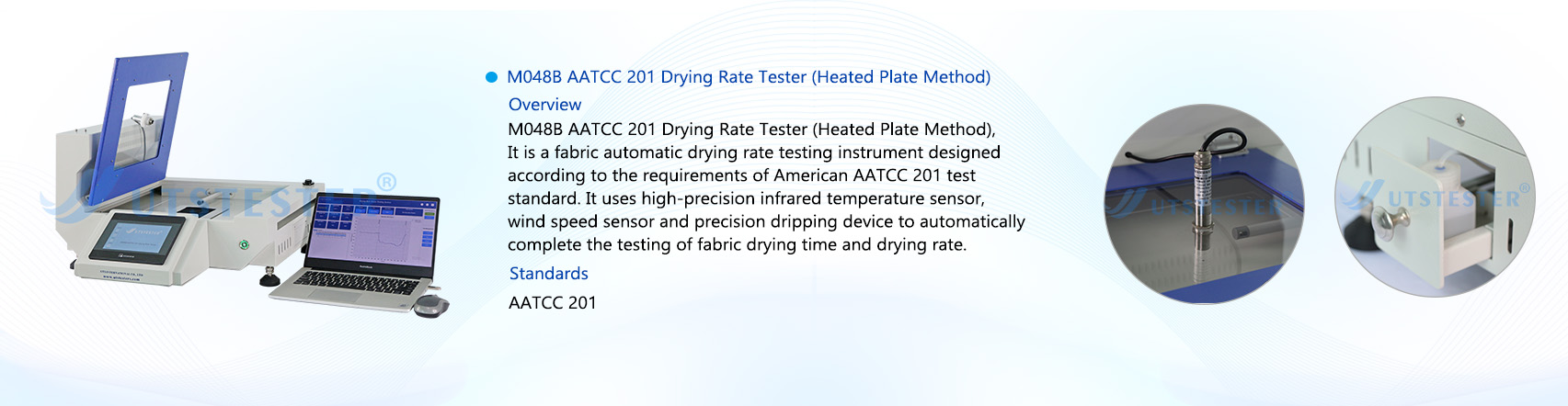
O método AATCC 201, também conhecido como método da placa aquecida, é um teste comumente usado para determinar a taxa de secagem de tecidos. A placa aquecida por contato é ajustada para 37 °C (100 °F), temperatura semelhante à do corpo humano. Isso simula a transpiração na pele. O método se aplica a diversos tipos de tecidos, incluindo malhas, tecidos planos e não tecidos.
4. Princípio de teste
A taxa de secagem de um tecido corresponde à sua taxa de evaporação. O tecido é colocado em contato com uma quantidade específica de água na interface de uma placa metálica aquecida a temperatura constante.
5. Método de teste
Preparação da amostra: Corte as amostras de tecido em um tamanho fixo (normalmente correspondente à área da placa aquecedora). Após o equilíbrio em condições ambientais padrão, molhe completamente as amostras e remova o excesso de umidade da superfície para garantir uma capacidade inicial consistente de retenção de líquidos.
Aquecimento por contato: Coloque as amostras úmidas sobre uma placa aquecedora com temperatura constante (simulando a temperatura da pele humana, normalmente ajustada para 33°C ± 1°C). A superfície superior das amostras é exposta a um ambiente com umidade e velocidade do fluxo de ar controladas.
Monitoramento dinâmico: Utilizando uma balança de precisão conectada à placa aquecedora, registre a massa da amostra em tempo real em intervalos fixos (por exemplo, intervalos de 5 minutos, 10 minutos) até que a massa se estabilize (peso constante), momento em que o teste é interrompido.
6. Cálculo e Aplicação de Dados
Cálculo de dados: De acordo com os métodos tradicionais, o cálculo principal é a “taxa de secagem por unidade de área”, utilizando a seguinte fórmula:
Taxa de secagem (g/(m²·h)) = (Massa em t₀ - Massa em t_n) / (Área da amostra × Intervalo de teste)
Além disso, registre o “tempo necessário para atingir o peso constante” e as “taxas de secagem em diferentes estágios” (por exemplo, fase inicial de secagem rápida, fase posterior de secagem lenta).
Aplicação dos Resultados: Utilizado principalmente para avaliar o "desempenho de secagem" de roupas íntimas, como determinar se as peças secam rapidamente após a transpiração, reduzindo a umidade e a sensação pegajosa. Também permite comparar o impacto de diferentes fibras ou processos de acabamento (por exemplo, acabamento hidrofóbico antibacteriano) no desempenho de secagem de tecidos íntimos.
E-mail:hello@utstesters.com
Telefone direto: +86 152 6060 5085
Telefone: +86-596-7686689
Web:www.uttesters.com


 +86 152 6060 5085
 English
 русский
 español
 português
 العربية
 Polski



 hello@utstesters.com
 hello@utstesters.com
 +86 152 6060 5085
 +8615260605085