A norma UL94 (Standard for Safety of Flammability of Plastic Materials for Parts in Devices and Appliances) é uma norma de segurança para a resistência à chama de materiais plásticos, desenvolvida pela Underwriters Laboratories (UL) nos Estados Unidos. Amplamente utilizada nas indústrias eletrônica, automotiva e da construção civil, ela serve como base fundamental para avaliar o comportamento de combustão de peças plásticas em ambientes com chamas. Seus resultados de testes e classificação são cruciais para a seleção de materiais e a conformidade do produto.
1. Tipos de teste UL94
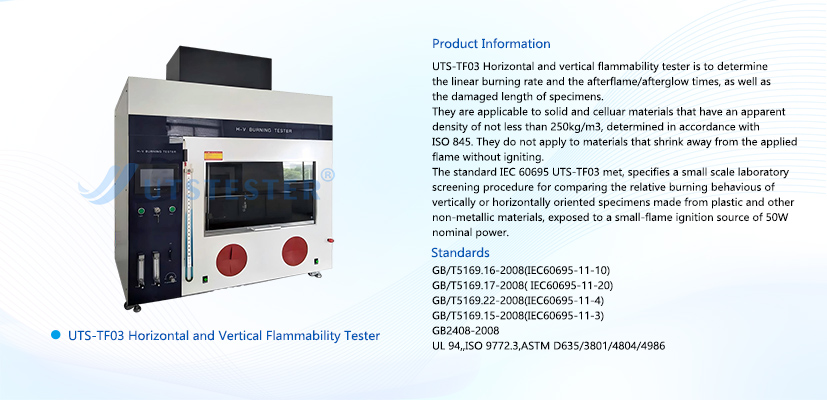
A norma UL94 utiliza diferentes métodos de teste para simular as condições de combustão de materiais em uso real. Ela é dividida em duas categorias principais: testes de combustão horizontal e vertical. Esses testes são projetados para materiais plásticos de diferentes espessuras e cenários de aplicação.
1. Teste de Queima Horizontal (Teste de Grau HB)
Âmbito de aplicação: Principalmente para materiais plásticos com espessura ≤13mm, este teste avalia a velocidade de combustão do material quando colocado horizontalmente. Este é o nível mais baixo de retardância à chama na norma UL94.
Procedimento de teste:
Prepare a amostra com dimensões padrão (125 mm de comprimento x 13 mm de largura x 3-13 mm de espessura) e fixe-a horizontalmente em um suporte. Marque a "linha inicial" em uma extremidade da amostra (a 25 mm da extremidade de ignição) e a "linha final" na outra extremidade (a 100 mm da linha inicial).
Utilize um bico de Bunsen (altura da chama de 20 mm, chama azul) para inflamar a amostra na extremidade de ignição por 30 segundos e, em seguida, remova a chama.
Observe o comportamento da combustão da amostra: se a chama se extinguir, registre o "tempo de pós-chama"; se a chama continuar queimando até a linha final, registre a "taxa de queima".
Requisitos de aceitação:
Se a chama não atingir a linha de corte e a chama residual durar ≤ 30 segundos, o teste é considerado aceitável.
Se a chama atingir a linha de corte, a velocidade de queima deve atender aos seguintes requisitos: Para espessura ≥ 3 mm, a velocidade de queima deve ser ≤ 40 mm/min; para espessura < 3 mm, a velocidade de queima deve ser ≤ 70 mm/min.
2. Teste de chama vertical (V-0, V-1, V-2)
Âmbito de aplicação: Este teste foi concebido para materiais plásticos com requisitos mais elevados de retardância à chama (como componentes internos e invólucros de aparelhos eletrónicos). Avalia indicadores-chave como a velocidade de extinção e a inflamabilidade por gotejamento do material após ser inflamado por uma chama quando colocado na vertical. Este é o tipo de teste mais utilizado na norma UL94.
Procedimento de teste:
Prepare a amostra nas dimensões padrão (125 mm de comprimento x 13 mm de largura x 0,8-13 mm de espessura) e fixe-a verticalmente em um suporte. Coloque uma camada de algodão medicinal seco a 300 mm abaixo da amostra (para verificar a ignição de qualquer material que goteje).
Acenda um bico de Bunsen (chama azul de 12,7 mm) no centro da extremidade inferior da amostra por 10 segundos. Remova a chama e registre o "tempo da primeira pós-chama" e o "tempo de incandescência residual" (a duração em que o material permanece vermelho após a chama se extinguir).
Após a chama residual e a luminescência residual da amostra se extinguirem completamente, reacenda a amostra com o bico de Bunsen por 10 segundos. Remova a chama e registre o "tempo da segunda chama residual" e o "tempo da segunda luminescência residual".
II. Pontos-chave nos testes UL94
Influência da Espessura da Amostra: As classificações UL94 estão fortemente correlacionadas com a espessura da amostra. Para o mesmo material, uma espessura maior pode resultar em uma classificação de retardância à chama mais alta (por exemplo, um plástico que atinge V-0 com 3 mm pode atingir apenas V-2 com 1 mm). Portanto, os relatórios de ensaio devem indicar claramente a espessura da amostra, e as classificações não podem ser aplicadas a todas as espessuras.
Requisitos do ambiente de teste: Os testes devem ser conduzidos em um ambiente padrão (temperatura de 23±2°C, umidade relativa de 50±5%). A temperatura e a umidade ambiente podem afetar o comportamento de combustão do material (por exemplo, alta umidade pode reduzir a velocidade de combustão) e devem ser rigorosamente controladas.
Prioridade de classificação: As classificações UL94, da mais alta para a mais baixa, são aproximadamente: 5VA > 5VB > V-0 > V-1 > V-2 > HB. A seleção deve ser baseada no cenário de uso do produto (como, por exemplo, se ele estará próximo a uma fonte de ignição ou se houver risco de gotejamento), em vez de buscar cegamente a classificação mais alta.
III. Aplicação da Norma UL94
Aplicações eletrônicas e elétricas: Componentes como invólucros de carregadores, substratos de placas de circuito impresso e isolamento de fios normalmente exigem uma classificação V-0 ou V-1 para evitar a propagação de incêndios ou a ignição de outros componentes por gotejamento de materiais.
Automotivo: Os componentes plásticos internos (como painéis de instrumentos e painéis de portas) devem estar em conformidade com a norma UL94 V-2 ou superior, sendo que algumas áreas de alta temperatura (como as ao redor do motor) exigem uma classificação 5VA.
Construção: Tubos de plástico e materiais decorativos exigem uma avaliação abrangente com base na classificação UL94 e nas normas locais de proteção contra incêndio em edifícios (como a norma chinesa GB 8624).
E-mail:
hello@utstesters.com
Telefone direto: +86 152 6060 5085
Telefone: +86-596-7686689
Web:
www.uttesters.com


 +86 152 6060 5085
 English
 русский
 español
 português
 العربية
 Polski


 hello@utstesters.com
 hello@utstesters.com
 +86 152 6060 5085
 +8615260605085